Let’s cut to the chase: if you’re in the stone quarry game, you already know the job’s not for the faint of heart. You’re dealing with dust that clogs every nook, extreme heat that melts grease, and sometimes terrain so rocky even your work boots slip. So here’s the question we get all the time from quarry managers, contractors, and even plant operators: can stone quarry machines hold up in these harsh environments? Stone Quarry Machine

As a stone quarry machine supplier, I’m not here to sell you a bunch of fancy jargon. I’m here to tell you the truth—because that’s what keeps our customers coming back year after year. The short answer is: yes, but only if the machines are built right, not just stamped with a “heavy-duty” label. Let’s break this down, no fluff.
First, let’s talk about what “harsh environment” actually means for a quarry. It’s not just one thing. You’ve got two main categories: on-site outdoor conditions and the daily grind of processing material. Outdoors, you’re looking at temperature swings—think 100°F (38°C) in the Arizona summer, freezing cold (-20°F / -29°C) in the Canadian Rockies, and sometimes heavy rain or even snow that turns loose dirt into mud. Then there’s the material side: silica dust that’s so fine it gets past most filters, sharp rock fragments that bounce around like tiny projectiles, and constant vibration from moving massive loads. Any machine that can’t handle these is going to break down faster than you can shout “stop the conveyor.”
Now, why do some machines fail in these environments? A lot of the cheap stuff you see online uses off-the-shelf parts that aren’t designed for quarries. Take a standard electric motor, for example. If you stick it in a quarry without a proper dust seal, silica dust will get into the windings in a week, and your motor’s fried. Or a gearbox that’s made for a warehouse forklift—run it 12 hours a day moving granite, and the metal will wear down in months, not years. We saw this a few years back with a small quarry in West Virginia: they bought a cheap impact crusher from a no-name brand, and it broke down three times in six months, costing them over $50k in downtime and repairs. That’s the problem with skipping quality.
But the good news? Modern quarry machines are built specifically for harsh environments, and they work. Let’s get into the specific features that make a difference, because this is where it’s not just marketing.
First, enclosures. Not just a metal box—enclosures that are rated for ingress protection (IP) codes. IP65 is the sweet spot for most quarries. What does that mean? Totally dust-tight, and can handle low-pressure water jets, so if you need to spray down the machine to keep dust from building up, or it rains really hard, nothing gets inside. We use IP65-rated control panels and motor housings on all our equipment, and we even offer IP67 for extra-dusty mines where they’re digging up quartz all day. Last year, a customer in a Nevada quarry told us their control panel ran for 18 months without a single filter change or dust issue—something that never happened with their old, unrated machines.
Next, materials. The parts that actually touch rock—like crusher jaws, conveyor belts, and screen mesh—can’t be made of regular steel. We use high-chromium alloy steel for crusher jaws; it’s way harder than standard steel, so it resists wear from rock impact. For conveyor belts, we use rubber with a steel reinforcement core and a cover that’s resistant to oil and tearing—because sharp rock will slice through a regular belt in no time. We also offer heat-resistant grease for bearings, so in 100°F weather, your bearings don’t seize up. A lot of suppliers use standard grease that breaks down in high temps, which is why their machines seize up mid-shift.
Then there’s climate-specific modifications. If you’re working in cold areas, we add block heaters for engines and motors, and we use synthetic oils that don’t thicken when it’s below zero. For hot, dry places, we add extra cooling systems for hydraulic parts and we make sure all electrical connections are sealed tight to prevent dust corrosion. We recently customized a set of screeners for a quarry in northern Alberta—they had -30°F winters, so we added heated screens to keep ice from building up on the mesh, which would stop the machine dead. The customer said that customization alone saved them $20k a year in downtime during winter.
But here’s the thing: even the best machine won’t work if you don’t maintain it right. I’ve seen guys with top-of-the-line quarry machines skip weekly filter changes because they think, “It’s sealed, I don’t need to.” Bad move. Silica dust will still find a way in if your air filter’s clogged, and that’s when you get motor overheating. We always tell our customers: a 30-minute check-in every day is way cheaper than a $10k repair after a breakdown. That’s part of why we offer free maintenance webinars for all our clients—no extra charge, because we want them to succeed.
Let’s talk real-world examples, because numbers matter. We have a customer in South Africa who runs a limestone quarry—their environment is super dusty, temperatures swing from 70°F to 110°F, and they work 12-hour shifts, six days a week. They bought two of our jaw crushers in 2021, and as of last month, they’ve only had one minor issue: a loose bolt that they found during a routine check. Their old crushers from another brand needed major repairs every 3 months. Another one: a customer in Norway, where it’s freezing for 8 months out of the year. They got our mobile quarry machine that’s built for cold conditions, and last winter, they ran it every day without stopping, even when it was -18°F. They said their previous machine from a big-name brand refused to start in temps below -10°F.
Now, I know what some of you are thinking: “These machines must be super expensive.” Yeah, upfront they cost more than the cheap stuff you see on Alibaba. But let’s do the math: if a cheap machine breaks down every 3 months, that’s 4 breakdowns a year, each costing $5k in repairs and $10k in lost production (because when your machine is down, you can’t sell stone). Our machines cost 20% more upfront, but they break down once a year, if that. Over 5 years, that’s $75k saved from downtime and repairs. That’s a no-brainer for most quarry owners—especially when margins are tight.
But it’s not just about the machine. We also design them to be easy to repair in the field. No special tools, no obscure parts you have to wait a week for. All our machines have modular parts, so you can swap a worn jaw in a couple hours instead of a whole day. That’s a big deal when you’re under pressure to meet a delivery deadline. Last year, a customer in Texas had a broken conveyor roller mid-shift, and our tech support walked them through replacing it over the phone in 45 minutes—no need to wait for a service truck that would take 2 hours to get there.
Wait, let’s address a common myth: some people think that “portable” quarry machines are less durable than stationary ones. Not anymore. Modern portable models have reinforced frames, heavy-duty axles, and the same IP-rated enclosures as stationary ones. We have a customer who moves their crusher between three different quarries in the US every month, and they’ve put 20,000 miles on their portable machine in two years—no major frame damage, no electrical issues. The key is that the portable models are designed to handle the constant moving and rough terrain of a worksite.
Of course, there are limits. If you’re talking about a quarry in a remote mountain area with no access to roads and constant heavy snow, even the best machine will need some extra work. But that’s why we offer customizations—we don’t sell a one-size-fits-all machine. We talk to you about your specific environment: how hot is it? How dusty? Do you work in cold? What kind of stone are you crushing? Then we build a machine that fits your needs, not a generic model.
At the end of the day, the question isn’t “can stone quarry machines be used in harsh environments?” It’s “will you buy one that’s actually built for it?” A lot of suppliers will tell you their machines are “heavy-duty,” but they’re just standard machines with a sticker. We don’t do that. Our job isn’t just to sell you a machine—it’s to make sure it works when you need it, no matter how tough the job gets.
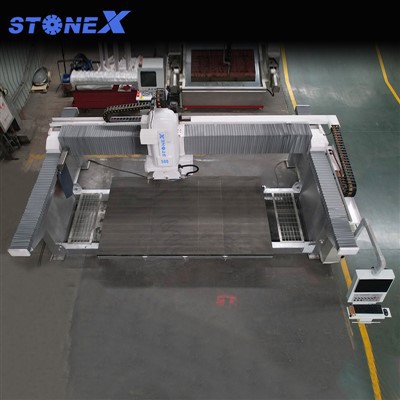
If you’re tired of machines that break down mid-shift, that need constant repairs, that cost you more money in the long run—let’s talk. I’m not here to pressure you into buying something you don’t need. I’m here to answer your questions, walk you through what features would work for your quarry, and give you the straight truth about what will hold up in your specific harsh environment. No jargon, no fluff, just what you need to keep your quarry running.
Block Cutting Machine References
- Mining & Quarry Plant. (2022). "Ingress Protection Ratings for Quarry Equipment: A Practical Guide." Global Industrial Machinery Association.
- Wear and Materials Science. (2021). "High-Alloy Steels for Abrasive Rock Applications." Journal of Manufacturing Processes.
- Quarry Management Magazine. (2023). "Cold-Weather Modifications for Mobile Quarry Equipment: Case Studies from Northern Operations." International Stone Industry Association.
Nantong Huayi Intelligent Equipment Co., Ltd.
Address: Dongsheng Stone Industry Park, Changjiang Town, Rugao City, Jiangsu Province, China
E-mail: claire@hualongm.com
WebSite: https://www.hystonemachinery.com/
